|
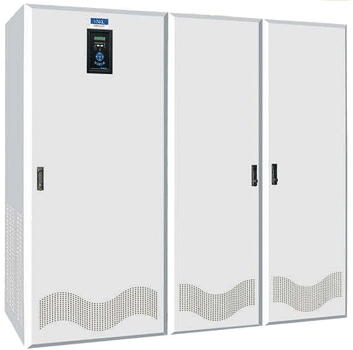
EnPower31/33
PROPERTIES
Standard Properties:
- IGBT Technology, SPWM
- Manual By-pass
- Automatic/ Intelligent Battery operations
- Adjustable charging current/ charging period
- Battery discharge control
- Remaining battery time
- Back-up time
- Battery temperature and charge with respect to temperature (compensation)
- Automatic and manual battery test
- UPS start from battery.
- Mains 50/60 Hz automatic sensing
- 255 warnings with occurrence time
- Displaying ambient temperature
- 8 programmable user contacts
- Multi-communication properties
- 0RS232 / RS485 Protocol
- Modem connection
- MOD-bus connection
- J-bus connection
- CAN bus connection
- SNMP protocol compatibility
- MEGATEC protocol compatibility
- Overload and short-circuit protection
- Maintenance free battery charging unit with adjustable number of cells
- Developed and Multi-lingual LCD panel
- Expandable battery run time
- Generator compatible
Optional Properties:
- (n+1) parallel configuration
- ECO-MOD operating mode
- Remote panel (observation and control)
- SNMP UNIVERSE
- Isolation Galvanic transformer at the input.
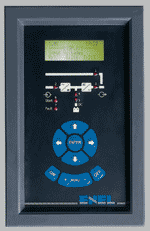
LCD FRONT PANEL:
Just looking at the mimic diagram on the front panel, you can easily get the operational status of the device. The LCD display, with two language options, displays many information such as input and output values (voltage, current, frequency etc.), battery voltage, battery charging and discharging currents, load percentage, bypass voltages etc. Some of the parameters can be calibrated using the buttons over this front panel. The changes in operational modes of the UPS are recorded with time and date. The user is facilitated to monitor the recorded past occurrences on the LCD display.
This panel facilitates the user to observe and control the UPS parameters from a certain distance. If installed within 1 km of the UPS device, it is possible to perform all the operations just like performing on the front panel on the device.
IGBT & PWM TECHNOLOGY:
A widely used and developed semi-conductor, IGBT (Isolation Gate Bipolar Transistor), are used in the inverter part of the UPS. With the Pulse Width Modulation technique, maximum operational efficiency is obtained and thus even the non-linear loads are fed with precise sinusoidal signal.
GALVANIC ISOLATION TRANSFORMER:
The isolation transformer at the output provides galvanic isolation. A UPS without isolation transformer at its output may cause danger to the connected loads in case there occurs a short circuit in the IGBT blocks of the inverter unit. In that case there is a high probability that the connected loads will be burnt or damaged due to high DC voltage.
Another advantage of the galvanic isolation transformer is that it eliminates the peaks (electrical noise or instant peaks) that might appear at the phase, neutral or earth line. For example, in a rainy day if there hits a lightning at the input, the electrical noise will not be able to pass through the transformer and thus will not affect the output voltage. As a result the loads remain safe.
ACQUIRED QUALITY CERTIFICATES:
At ENEL, quality and customer satisfaction are given the highest priority. As a result ENEL obtained the following quality certificates and maintains the standards with due importance.
- TSEK
- ISO 9001 (NQA)
- EN 50091-1 (Safety)
- EN 50091-2 (EMC)
POWER FACTOR CORRECTION (PFC):
Power Factor Correction unit is available at the input stage of UP11MS and UP31MS model ENEL UPS devices. While the input power factor is around 0.8 in a normal device without PFC, the ratio is in between 0.95-0.99 in a UPS with a PFC unit. The nearer the power factor to 1, the less electric bill is paid for the re-active power used. At the same time the system efficiency is enhanced and less current is drawn at the UPS input. As the input current is less, you would be benefited while purchasing a generator with low current rating. Another advantage of using a UPS with PFC unit is that it does not distort the mains supply. As a result the other electronic devices connected to the mains run safely without any interruption.
DRY CONTACTS (based on UPS Status):
In UP11MS model UPS there are 8 dry contact information for the user. These are as follows:
- Load On By-Pass
- Load On Battery
- Battery Depleting
- Load On Inverter
- Overload
- General Fault
Besides these, there are two more contacts available to customize according to the customers demand.
PARALLEL CONFIGURATION:
Parallel configuration is a system, which ensures more sensitive and reliable operation of the UPS to continue feeding the load. Because, in a parallel configuration even if one unit of the UPS goes out of order, the other units still operate and thus ensures a continuous feeding of the load without transferring the load to bypass. In this system n+1 units can be connected in parallel and thus altogether increase the total capacity of the system. In this way, whenever necessary, the user can add an extra unit to feed a larger load system.
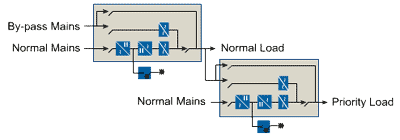
Hot Stand-by Configuration:
- Feed one (priority) or two (priority & normal) load banks depending on the application need
- Increase the reliability of the priority load
- Increase the maintainability
- Easy connection
- Can be implemented in the existing installation regardless of the UPS size, the generation (of device, technology or control mechanism).
n+1 Modular Parallel Configuration:

- Up to six modules in parallel
- Increase the system reliability
- Increase the availability of quality power following the load demand even if it was not forecasted or planned at the beginning of the project: ease of techno-economic expandability
- Increase the maintainability
- Even though the total load is less than or equal to the rating of the single UPS (depending on the desired redundancy level), the load is shared between all modules.
|